
News Wire
Building India’s EdTech and AI Roadmap for Equitable Learning for Every Child
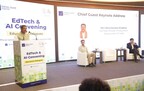
- Central Square Foundation (CSF) hosted the EdTech and AI Convening – Education Dialogues, a satellite event of the India AI Impact Summit, convening senior government leaders, philanthropies, global and Indian EdTech innovators, and education experts to reimagine how technology and AI can support learning at scale.
- The second edition of the Bharat Survey for EdTech (BaSE) launched – a unique, large-scale national survey by Central Square Foundation that offers insights across 10 States on access to, use of technology for teaching & learning among parents, teachers & children, and AI awareness among 12,500 underserved communities and households.
- Leaders underscored that evidence-backed innovation, strong system design, and cross-sector collaboration are critical to delivering measurable learning gains at scale.
NEW DELHI, Feb. 20, 2026 /PRNewswire/ — Central Square Foundation (CSF) hosted the EdTech and AI Convening – Education Dialogues, a satellite event of the India AI Impact Summit, convening senior government leaders, philanthropies, global and Indian EdTech innovators, and education experts to reimagine how technology and AI can support learning at scale.

Delivering the keynote address, Chief Guest Shri Dharmendra Pradhan, Hon’ble Education Minister, Government of India, spoke about the pathway towards achieving a Viksit Bharat by 2047 – where technology and AI become integral to ensuring quality education for all, empowering teachers, and preparing young people for the future of work.
Speaking at the launch of the Bharat Survey for EdTech 2025 Report, Shri Dharmendra Pradhan said, “Under the leadership of PM Modi, Digital India has truly come alive as a powerful means of empowerment. Rapid adoption of technology is part of India’s DNA. Our commitment is clear — technology must connect to every aspect of life and be integrated into everyday living so that it delivers ease, opportunity, employment, and empowerment. If you look at the BaSE (Bharat Survey for EdTech) report launched today by Central Square Foundation, you will see how deeply digital access has expanded across India — smartphones have proliferated, internet access has grown significantly, and AI preparedness is steadily rising. The foundation of this transformation is education. When technology is anchored in education, it becomes far more than an infrastructure upgrade — it becomes a powerful equaliser because it enables broad participation and makes education more democratic. I can say with confidence that we are moving in the right direction, building pathways for the next generation of India — and for the world.”
The event was also graced by Shri Sanjay Kumar (IAS), Secretary, Department of School Education & Literacy, Ministry of Education, Government of India, who highlighted the transformative impact of NIPUN Bharat in classrooms nationwide—from more confident readers to stronger number sense. He called for a bold integration of technology across every layer of the mission to ensure these gains are not only sustained, but accelerated. He said, “The launch of the Bharat Survey for EdTech (BaSE) 2025 is an important development for strengthening evidence-based policymaking in school education. A comprehensive, pan-India understanding of how EdTech is accessed, adopted, and used — particularly across underserved geographies — will enable us to better align policy, programme design, and implementation frameworks with ground realities. The insights from this report will help identify adoption gaps, infrastructure constraints, and capacity needs at the last mile. This, in turn, will support more targeted interventions, improved resource allocation, and stronger monitoring mechanisms to ensure technology investments translate into measurable learning outcomes at scale for all.”
In his address, Ashish Dhawan, Founder-Chairperson, Central Square Foundation said, “We are at a rare inflexion point where India’s strong digital foundations, growing evidence on what works, and the rapid rise of AI can together reimagine how we support every child’s learning — but only if innovation remains intentional, pedagogically grounded, and relentlessly equity-first.”
Shaveta Sharma-Kukreja, Chief Executive Officer and Managing Director, Central Square Foundation, while delivering the welcome address said, “Over the past decade, technology has steadily reshaped how our children learn, how teachers are trained and teach, and how systems think about scale. And today, with the rapid emergence of Artificial Intelligence, we find ourselves at a critical point — one that calls for both optimism and responsibility. The launch of the Bharat Survey for EdTech 2025 gives us key ground-level insights into how low-income households, students and teachers are actually accessing and using these technologies. We hope to see these help inform governments, innovators, civil society and philanthropies to ensure they truly serve every learner.”
A Global Moment for AI in Education
The Convening opened with reflections on the global moment for AI in education, as AI rapidly enters classrooms worldwide—unlocking new possibilities to personalise learning, empower teachers, and strengthen education systems. Benjamin Piper, Director, Global Education at the Gates Foundation underscored that realising this promise will require rigorous evidence, a strong equity lens, and context-sensitive implementation to ensure AI meaningfully benefits all learners, particularly those in low-resource settings. The Convening also showcased a range of pioneering innovations, from India and globally, in AI-led EdTech, illustrating how technology is being creatively leveraged to enhance teaching and learning across diverse contexts.
Building the Evidence Base for AI in Education
As AI tools proliferate in education, global and national leaders alike called for rigorous data and research to guide their effective use. Reinforcing this emphasis on data, Shri Amitabh Kant, former CEO, NITI Aayog, former G20 Sherpa (India), launched the 2nd edition of the Bharat Survey for EdTech (BaSE), a unique large-scale national survey by Central Square Foundation that provides insights on access to and use of technology for teaching and learning among parents, children and teachers from low-income backgrounds in India. Conducted across 10 states, the survey reached 12,500 households and 2,500 teachers from government and affordable private schools, exploring the foundational themes of access to, use of technology for teaching & learning among parents, teachers & children. The additional theme for BaSE 2025 was on AI awareness and use for teaching and learning. The findings signal that Bharat is increasingly going digital with 90% of households owning at least one smartphone and 63% of children already using technology for learning.
Scaling what works
Nobel Laureate Prof. Michael Kremer, & Director, Development Innovation Lab at the University of Chicago, emphasised that AI’s potential to improve learning outcomes must rest on clear, measurable evidence of efficacy – ensuring that innovation aligns with what truly drives impact in the classroom.
The discussions also highlighted what it takes to move from promising pilots to impact at scale, underscoring the importance of clear evidence on learning gains, enabling policy and infrastructure, and strong partnerships to ensure that effective approaches reach millions of children, not just a few projects.
Building Foundations for Responsible AI
Leaders from government, policy, and the innovation ecosystem discussed how India is building the architecture for the responsible and equitable deployment of AI in education.
The session outlined India’s vision to democratise AI through education-first digital public infrastructure, with the India AI Impact Summit advancing this agenda through the IndiaAI Mission’s investments in compute capacity, safe language models, and high-quality datasets. Bodhan AI, Centre of Excellence in AI for Education was highlighted as a key vehicle to translate this infrastructure into system-ready solutions and build capacity for responsible, scalable adoption across public education systems.
Flowing from this vision, the convening spotlighted AI Samarth—launched by Central Square Foundation with support from Google.org in 2024 — as India’s first structured, contextualised initiative to build AI literacy at scale among students, teachers, and parents from underserved communities—while Maggie Johnson, Global Head of Google.org, emphasised the importance of strengthening infrastructure and building institutional capacity to ensure communities across the Global South can meaningfully participate in and benefit from the AI transformation.
While giving the Plenary Address, Amitabh Kant, former CEO, Niti Aayog and Former G20 Sherpa (India) said, “This session is meaningful and of critical importance for both Global South and India. The BaSE 2025 report shows that access is no longer the primary bottleneck. The pressing question is whether increased access to devices is actually translating into improved learning. If India aspires to become a Viksit Bharat by 2047, that ambition cannot be realised without improvement in learning outcomes.”
While speaking at a Fireside chat on ‘Building Blocks for Responsible AI‘, Prof. B. Ravindran, Board Member, Bodhan AI, Centre of Excellence in AI for Education, IIT Madras, said, “It is important to know what the state of the system is and what the ground reality is. So we can understand a lot about what the ground reality is from these kinds of surveys and then go and solve for what AI needs to do.”
Speaking at a Fireside chat on Building AI Literacy for the Global South, Maggie Johnson, Global Head, Google.org, talked about the importance of including the community. “It is important to build with the community, design with the community and design for scale. Taking time to be in the community and understanding what it takes to use that technology and build that solution for them. These are some design principles that we have to assume in the Global South that devices will be outdated so anything that you build needs to be at scale also. You want to think about ‘Scaling’ early on in the process.”
About Central Square Foundation
Founded in 2012, Central Square Foundation (CSF) is a non-profit committed to improving learning outcomes for school-going children across 14 Indian states through system-led reform. We work in close partnership with 11 state governments to design and deliver statewide missions on Foundational Literacy and Numeracy (FLN), while strengthening Early Childhood Education. CSF also focuses on building a vibrant EdTech and AI ecosystem to enable equitable, high-quality learning at scale. Our work extends to strengthening school governance across government and affordable private schools, and supporting High Potential Students (HPS) from underserved communities to become future innovators, researchers, and leaders. More on https://www.centralsquarefoundation.org
 View original content to download multimedia:https://www.prnewswire.com/in/news-releases/building-indias-edtech-and-ai-roadmap-for-equitable-learning-for-every-child-302692827.html


News Wire
Reliance Digital Launches ‘Baaptaa’, a Father’s Day Campaign Celebrating the Many Expressions of Fatherhood

MUMBAI, India, June 20, 2026 /PRNewswire/ — Reliance Digital has launched ‘Baaptaa’, a Father’s Day campaign to celebrate the many expressions of fatherhood. Built around a simple cultural observation, while “Maa ki Mamta” has long been a part of India’s collective vocabulary, there has never been a word that captures the distinct ways fathers express love, the campaign introduces ‘Baaptaa’ as a tribute to the many shades of fatherhood.

Conceptualised as an original music-led campaign, Baaptaa celebrates fathers not as idealised figures, but as they are experienced in everyday life, protective, dependable, emotional, quirky, practical, occasionally embarrassing, and always present. Through a relatable narrative, the campaign acknowledges the countless ways fathers care for their families, often through actions rather than words.
Watch Video: https://youtu.be/9XyUsJB33Ds?si=PM67vhxrzth1JEkz
At the heart of the campaign is an original music video told from a father’s perspective, capturing the different roles he plays across life’s moments and milestones. The film brings to life the humour, warmth and unspoken affection that characterise father-child relationships, while giving a name to a form of love that many recognise but few have articulated.
The campaign stems from a simple insight: while motherhood has often found expression through familiar phrases and popular references, the unique language of fatherhood has remained largely undefined. Baaptaa seeks to fill that gap by creating a term that reflects the everyday gestures, practical wisdom and quiet sacrifices that fathers make.
Father’s Day communication often leans into familiar emotional territory, but Reliance Digital’s campaign celebrates fathers in a way that feels more culturally authentic and relatable. The idea for ‘Baaptaa’ came from a simple observation — mother’s love has been immortalised in a number of heartfelt, emotional songs, there needed to be an anthem dedicated to dad’s love. And thus was born Baaptaa – a love language that is often awkward, practical, protective, humorous and deeply felt, even if rarely verbalised. It’s a celebration of fatherhood in all its wonderfully imperfect forms immortalized by a song that you won’t be able to stop humming.
Shop for the widest range of electronics at Reliance Digital and thank your father for his Baaptaa.
 View original content to download multimedia:https://www.prnewswire.com/in/news-releases/reliance-digital-launches-baaptaa-a-fathers-day-campaign-celebrating-the-many-expressions-of-fatherhood-302805505.html

News Wire
Harper Collins Publishers India is Delighted to Announce the Recent Publication of ‘People We Love’ by Preeti Shenoy

NEW DELHI, June 19, 2026 /PRNewswire/ — HarperCollins Publishers India is delighted to share the recent publication of People We Love by bestselling author Preeti Shenoy. At once tender and sharp, this collection of stories offers intimate, truthful and relatable portraits of the people we cherish, the ones we lose, and the people we become.

ABOUT THE BOOK
The people we love never truly leave our story…
In these tender yet piercing stories, Preeti Shenoy returns to some of her most beloved characters to reveal who they were before they appeared in her bestselling novels It’s All in the Planets and The One You Cannot Have.
Aniket, a coder, carries the weight of a longing for Trisha that he cannot bring himself to act on. Nidhi abandons her corporate life to teach pottery, only to discover that clay is far more forgiving than the people she loves. A quiz competition sparks an unlikely romance between Aman and Shruti, one that must withstand parental disapproval and class divides. And Anjali, a journalist, is so busy chasing stories that she almost misses the one unfolding in her own life.
Set against the pulse of contemporary India, People We Love explores the tug-of-war between duty and desire, family and freedom, who we are and who we dare to be. Intimate and deeply felt, these are stories about love that stays, leaves and almost slips away … love that quietly and irrevocably shapes the people we become.
Preeti Shenoy, author, says, “People We Love is a collection of three long stories, prequels to my bestsellers It’s All in the Planets and The One You Cannot Have. If you have read those books, you already know how these characters’ stories unfold. But what you don’t know yet is where it all began, the loves they carried, the choices they made, and the people they were before life shaped them into who you met on those pages. Writing these prequels felt like returning to a home I hadn’t realised I missed, and discovering rooms I had never been in before.”
Rashmi Menon, Associate Publisher – HarperCollins India, adds, “Preeti Shenoy has an extraordinary gift for finding the heartbeat of ordinary lives. People We Love is a warm, wise and deeply humane collection of short stories that reunites readers with favourite characters from her bestselling novels It’s All in the Planets and The One You Cannot Have, weaving them into fresh, deeply satisfying narratives. These characters feel like people you know, and their journeys will move, comfort and surprise you. This uplifting, thought–provoking collection reminds us why we turn to stories in the first place. We couldn’t be more excited to share it with our readers.”
ABOUT THE AUTHOR
Preeti Shenoy is among the highest-selling authors in India. She was featured on the Forbes longlist of the most influential celebrities in India. Her books include When Love Came Calling, Wake Up Life, Is Calling, Life Is What You Make It, The Rule Breakers, A Hundred Little Flames, It’s All in the Planets, Why We Love the Way We Do, The Secret Wish List, The One You Cannot Have and many others. Her work has been translated into many Indian languages. Preeti is also a motivational speaker, an avid fitness enthusiast, and an artist specializing in portraiture and illustrated journalling. Preeti lives in Bengaluru, Karnataka.
ABOUT HARPERCOLLINS PUBLISHERS INDIA
At HarperCollins Publishers India, we believe in telling the best stories and ensuring they reach the widest readership. We publish around 250 new books every year across 10 imprints, adding to a diverse catalogue of more than 3,000 titles in print and digital formats, with an array of genres and voices that ensure there is a book for every reader. Our authors have won some of the most prestigious literary awards, and we are proud to publish many acclaimed writers, alongside new and emerging voices shaping contemporary literature. We are also the publishers of The White Tiger by Aravind Adiga, winner of the Booker Prize 2008, and Girl in White Cotton by Avni Doshi, shortlisted for the Booker Prize in 2020, and HarperCollins India itself has been awarded “Publisher of the Year” several times. In addition, we represent some of the finest global publishers such as Harvard University Press, Lonely Planet, Oneworld, Nosy Crow, Usborne, and National Geographic Children, bringing Indian readers access to world-class books and ideas. We are also proud to be certified as a Great Place to Work for two consecutive years, a recognition of our culture, people, and values that make HarperCollins India a truly inspiring workplace.
PRESS CONTACT:
Nandini Tripathi, Manager – Marketing (Commercial)
Email: nandini.tripathi@harpercollins.co.in | Mobile: +91 9718928839
Photo: https://oyefilmy.com/wp-content/uploads/2026/06/harper-collins-publishers-india-is-delighted-to-announce-the-recent-publication-of-people-we-love-by-preeti-shenoy-1.jpg
Logo: https://mma.prnewswire.com/media/2105077/4665143/HarperCollins_Logo.jpg

 View original content to download multimedia:https://www.prnewswire.com/in/news-releases/harper-collins-publishers-india-is-delighted-to-announce-the-recent-publication-of-people-we-love-by-preeti-shenoy-302805348.html

News Wire
Fulfilling PM Modi’s Dream of Atmanirbhar Bharat: India’s AI Writing Startup Kreativespace Incubated at IIT Kharagpur

- Kreativespace, an Indian AI-powered writing platform founded by Vinet Kakadea, has been incubated at IIT Kharagpur and recognized by SVNIT University, Ministry of Education under Bodhan AI Conclave also through the NVIDIA Inception Program, AWS Startup Program, and DPIIT under Startup India.
- The platform unifies 8 AI-powered writing tools, along with AI Humanizer and Message AI feature being the latest addition into a single ecosystem, so you can generate and refine content all in one place.
- The company reports more than 50,000+ signed-up users, 75,000+ anonymous users, and roughly 100,000 monthly website visitors, positioning itself as the only Indian company operating at scale in the global AI writing market.
SURAT, India, June 19, 2026 /PRNewswire/ — Kreativespace, an AI-powered writing platform, is building out its position as the only homegrown alternative in a market long dominated by international tools such as Grammarly and QuillBot. Founded by Vinet Kakadea and incubated at IIT Kharagpur, the company has aligned its growth with the broader push behind Prime Minister Narendra Modi’s Atmanirbhar Bharat (Self-Reliant India) initiative, which encourages indigenous technology development capable of competing on a global scale.

As AI adoption accelerates across India’s education, research, and enterprise sectors, Kreativespace is among a small group of Indian startups building writing technology designed to compete directly with established international platforms.
Kreativespace’s progress has been recognized by several institutions central to India’s startup and technology ecosystem. The company has been incubated at IIT Kharagpur, selected under SSIP 2.0 through SVNIT University, and chosen by the Ministry of Education to present its work at the Bodhan AI Conclave. It has also been accepted into the NVIDIA Inception Program and the AWS Startup Program, and holds DPIIT recognition under the Startup India initiative.
Where many writing-tool users rely on separate subscriptions for content generation to refinement for grammar correction, paraphrasing, plagiarism checking, citation generation, and editing, Kreativespace brings these functions into a single platform as a super-app for AI writing tools. The company says its approach centers on affordability and accessibility alongside performance, aiming to make advanced AI writing assistance available to a wider range of users regardless of geography or budget.
The idea for Kreativespace took shape while founder Vinet Kakadea was studying at New York University and Marymount University in the United States, where he experienced firsthand how students, researchers, and professionals often need multiple paid subscriptions to cover writing-related tasks. That fragmented experience led him to build a super-app offering each of these capabilities together, at a more accessible price point.
Kreativespace combines 8 AI-powered writing tools with AI Humanizer and Message AI feature being the latest addition, allowing users to generate, rewrite, refine, and humanize content without moving between separate platforms. The product is available via web platform, mobile apps on the App Store and Google Play, browser extensions for Chrome, Mozilla, and Edge, and a Google Docs add-on.
Vinet Kakadea, Founder of Kreativespace, said, “Kreativespace’s vision is to digitalize the entire Indian education ecosystem to support PM Modi’s Atmanirbhar Bharat scheme.”
About Kreativespace
Kreativespace with the Motto of Making Writing Accessible for Everyone: Kreativespace is an AI-powered writing platform built to make AI writing tools accessible, affordable, and effective for students, researchers, educators, professionals, content creators, startups, and enterprises. Founded by Vinet Kakadea, the company is incubated at IIT Kharagpur and has been recognized by AWS Startup Program, the NVIDIA Inception Program, and DPIIT under Startup India. For more information, visit kreativespace.com.
 View original content to download multimedia:https://www.prnewswire.com/in/news-releases/fulfilling-pm-modis-dream-of-atmanirbhar-bharat-indias-ai-writing-startup-kreativespace-incubated-at-iit-kharagpur-302804117.html


Reliance Digital Launches ‘Baaptaa’, a Father’s Day Campaign Celebrating the Many Expressions of Fatherhood
Reliance Digital Launches ‘Baaptaa’, a Father’s Day Campaign Celebrating the Many Expressions of Fatherhood

Canara HSBC Life Insurance Celebrates Father’s Day with a Heartwarming Tribute to Dad Jokes


-

 Buzz2 months ago
HOP Events, helmed by Kalpesh Kinariwala, bridges Indian talent and global prestige at the Shows of India 2026 Conclave
-

 Buzz2 months ago
Firstsource Partners with Typeface to Launch Agentic Marketing Services
-
News Wire2 months ago
HOP Events, helmed by Kalpesh Kinariwala, bridges Indian talent and global prestige at the Shows of India 2026 Conclave
-

 Buzz2 months ago
Shaping Future-Ready School Leaders: Woxsen University Leads Design Thinking Initiative for Principals
-

 News Wire2 months ago
Reliance Digital’s ‘All About Apple’ Campaign Brings Best Apple Deals and Price Drops on iPhone 17, MacBook & More
-

 News Wire2 months ago
HarperCollins is proud to announce the publication of The Book of Daily Brilliance: 111 Days to Transformation by Pamela Puja Kirpalani
-

 Buzz2 months ago
MSEED and SCOPE Global Skills University Sign Strategic Partnership to Shape the Future of Experiential Marketing Education
-
News Wire2 months ago
Firstsource Partners with Typeface to Launch Agentic Marketing Services
You must be logged in to post a comment Login