

How-tos
How to make your city look like an open-world video game with AI
We made a 30-second trailer for a game that does not exist, set in an Indian city. Here are the prompts, the edit and the rules we kept to.
Why we made a trailer for a game that does not exist
The biggest game launch in years landed this week, on two consoles only. In India that is a small club: by one industry estimate there are about 800,000 of those consoles in the country, and the game costs Rs 5,999 on top. Far more people are watching than playing.
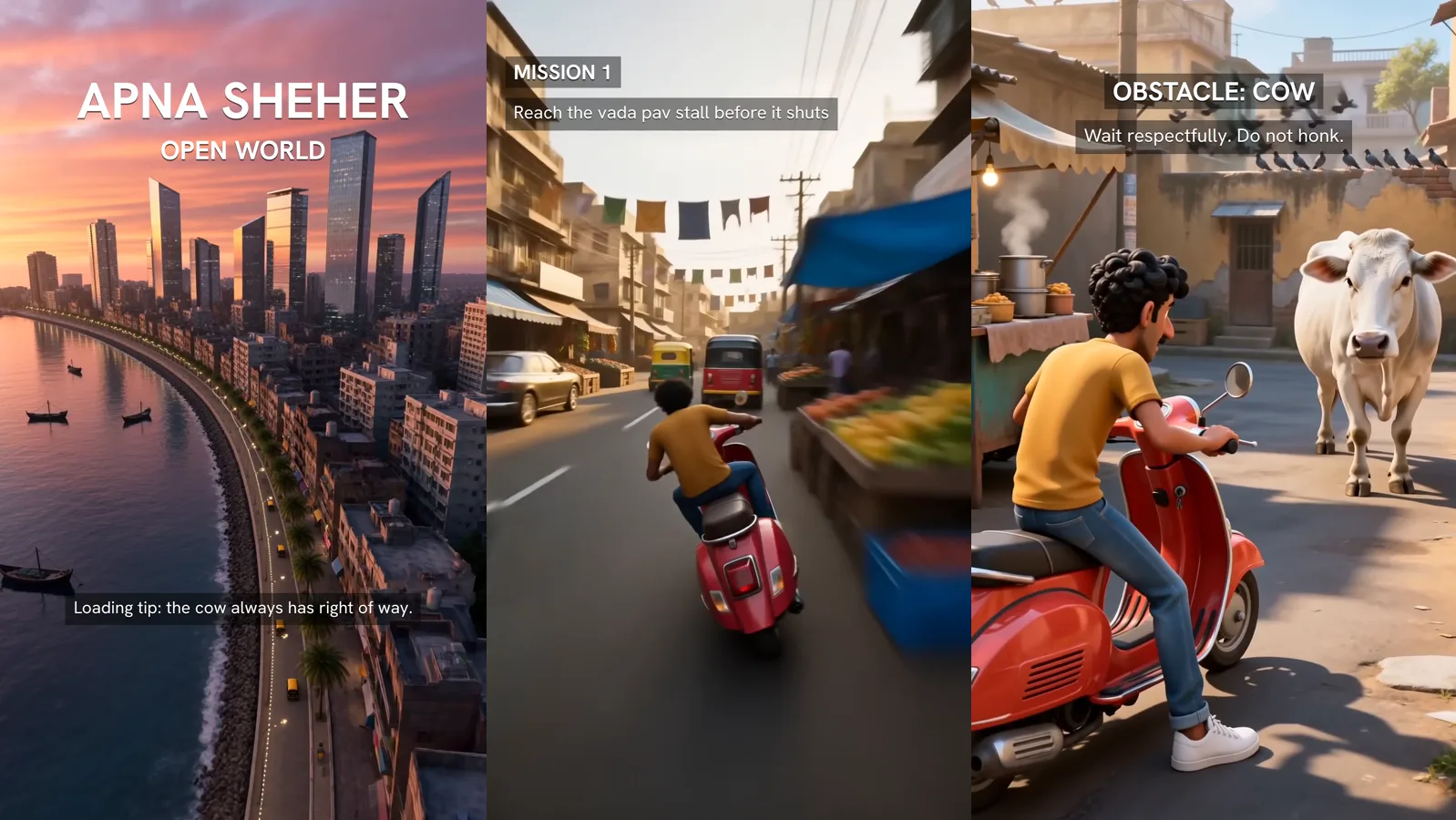
So we skipped the reaction post and made our own game instead. Apna Sheher: Open World is set in an invented Indian coastal city. Mission 1 is to reach the vada pav stall before it shuts. The obstacle is a cow. Nothing in it comes from any real game: no name, no logo, no footage.
The wording that gives you the game look
A video model draws what you name. "Cinematic" gets you a film. To get a game, name the things that make a game look like one: where the camera sits, how the picture is rendered, and what must not appear. We ended every shot with the same paragraph:
The whole shot looks like third-person gameplay from a big-budget open-world video game: stylised but realistic game graphics, vivid saturated colours, crisp game lighting with soft bloom, smooth game camera. An invented Indian coastal city, not a real place. No HUD, no on-screen text, no subtitles, no logos, no brand names, no watermarks, 9:16 vertical.
| Words | What they change |
|---|---|
| third-person gameplay | Puts the camera behind and slightly above the character, the way a chase camera sits |
| stylised but realistic game graphics | Gives the slightly smooth, lit-from-everywhere look of a game engine |
| an invented city, not a real place | Keeps real buildings and real shop names out of the frame |
| no HUD, no on-screen text | Models misspell text. Leave the frame clean and add your own in the edit |
| no logos, no brand names | Keeps vehicles and signs generic |
The six shots
Each shot is five seconds and holds one action. The character and his scooter are described once and pasted, unchanged, into every shot that has them. That repetition is the whole trick to keeping him the same. The Seedance prompt guide explains why.
Raju, a fictional lean Indian man in his twenties who does not resemble any real person: curly black hair, a thin moustache, a mustard-yellow short-sleeve shirt, blue jeans and white sneakers. A plain cherry-red scooter with no logos or number plate text.
| Shot | What happens | Caption added in the edit |
|---|---|---|
| 1 | Aerial glide down over a sunset coastal city | APNA SHEHER: OPEN WORLD |
| 2 | Chase camera behind the scooter in a market street | Mission 1: reach the vada pav stall before it shuts |
| 3 | He brakes for a cow standing in the lane | Obstacle: cow. Wait respectfully. |
| 4 | He gets his vada pav and holds it up | MISSION PASSED |
| 5 | Rainy night chase, an auto-rickshaw behind him | Wanted level 3: you owe the auto driver Rs 10 change |
| 6 | Sea wall at sunset, the lights come on | Your city. Your game. |
Third-person chase camera, low and close behind Raju, riding a plain cherry-red scooter fast down a crowded Indian market street at golden hour. He weaves between black-and-yellow taxis, green-and-yellow auto-rickshaws and a red double-decker city bus; fruit carts, hanging laundry and tangled overhead wires rush past on both sides. The camera stays locked behind him and leans with every turn.
Third-person camera behind Raju on the scooter. He brakes hard and skids to a stop in a narrow Indian lane because a large calm white cow is standing in the middle of the road, chewing slowly and staring at him. He raises both hands in apology and waits. Pigeons take off from a wall, a tea stall steams at the side. The camera settles behind his shoulder, framing the cow.
All six ran on Seedance 2.0 text to video at 1080p, 9:16, five seconds, with no retakes. If you are choosing a model, our comparison of the AI video generators shows how they differ.
Missions, captions and music go in the edit
- Write the jokes as game text. A mission, an obstacle, a reward, a wanted level. The picture is the set-up; the caption is the punchline.
- Keep captions in the top third or the middle of a vertical video, clear of the app's buttons and your own caption at the bottom.
- Use a plain bold font on a soft dark backing. Do not copy a real game's lettering.
- Use original music. We generated a 30-second instrumental and asked for it to be "not based on any existing song or game theme".
- Say it is AI. We put "A game that does not exist. Made with AI." on the last shot and ticked the AI label when posting.
Make your own city
Change three things: the city's look, the vehicle, and the mission. The mission is where your city shows.
| City feel | Vehicle | Mission | Obstacle |
|---|---|---|---|
| Winter fog, wide roads, metro pillars | Yellow-and-green auto-rickshaw | Get chole bhature before the queue | A wedding procession with a brass band |
| Tech parks and flyovers | Delivery scooter | Reach the office 2 km away | The traffic jam is the final boss |
| River bridge at dawn, old trams | Yellow taxi | Reach the sweet shop before the fresh batch sells out | A tram that will not be hurried |
Third-person chase camera, low and close behind a fictional young man in a mustard-yellow shirt riding a plain red scooter through a crowded market street in an invented Indian city at golden hour, weaving between taxis and auto-rickshaws. It looks like third-person gameplay from a big-budget open-world video game: stylised but realistic game graphics, vivid colours, smooth game camera. No HUD, no on-screen text, no logos, 9:16 vertical.
Paste it into the Video Studio, or into Chat, which will offer you a card with the model, the length and the price before anything is made. Five seconds on Seedance mini 2.0 is the cheapest way to test the look.
Put yourself on a game loading screen
The other format people are sharing this week is a painted portrait of themselves in the style of a game's loading screen. It is an image edit: one photo in, one illustration out.
Turn this photo into a hand-painted loading-screen illustration for a made-up open-world video game set in an Indian city. Keep my face and hair recognisable. Bold comic-style ink outlines, flat painted colours with strong shadows, a sunset palette of orange, pink and teal. Three-quarter view, confident pose, a scooter and palm trees behind me, a city skyline at dusk. No text, no logos, no game titles.
Use your own photo, or one you have permission to use. A product can take the same treatment; our guide to making a product video ad from a photo covers that.
What to leave out
- A real game's name, logo, characters, map or footage. They belong to the studio, and videos using them have been taken down.
- Titles like "trailer", "leak" or "gameplay" that could make someone think it is the real thing. Say what it is: a game that does not exist.
- Feeding official artwork to a model. That is still their artwork.
- Real people in crime scenes, and real public figures in anything.
- Unlabelled AI. Tick the AI label where the app offers one.
Which AI model is best for a game-style video?
We used Seedance 2.0 text to video at 1080p. Seedance mini 2.0 is cheaper and good for testing the look at 720p. The wording matters more than the model: name the third-person camera and the game graphics.
How do I keep the same character in every shot?
Describe the character once in detail (hair, clothes, colours) and paste the same words into every shot. For a tighter match, use a reference image with a reference-to-video model.
Can I use a real game's name in my video?
Leave it out. Studios own their names, logos and characters and do remove videos that use them, especially ones that look like official trailers. An invented game is safer and is your own idea.
Why is there no text in the generated shots?
Video models often misspell text. We asked for none and added the mission captions afterwards in the edit, where the words are exact.
How long does it take?
Each five-second shot at 1080p took a few minutes to render. Six shots, the captions and the music took about an hour end to end.
Make your city into a game
Start with one five-second shot, get the look right, then build the other five.